
Our Story

Our Mission
The Samuel D. Outlaw Blacksmith Memorial Museum preserves, interprets, and activates the legacy of Samuel D. Outlaw—an African American master blacksmith and wheelwright who served Virginia’s Eastern Shore as a skilled craftsman, entrepreneur, and community leader for more than fifty years.
Introduction and Background
The Samuel D. Outlaw Blacksmith Shop Memorial Museum is one of the last surviving intact blacksmith shops in Virginia. Operated by Samuel D. Outlaw from 1927 until 1991, the shop served generations of Eastern Shore farmers, watermen, and families, providing indispensable services and standing as a symbol of Black economic resilience during an era of segregation.
Today, the shop remains a rare, tangible link to this history. It is individually listed on the National Register of Historic Places, the Virginia Landmarks Register, and recognized by the African American Civil Rights Network.
Leadership and Community Role
Gerald Boyd, M.Div., serves as Director and Curator of the Samuel D. Outlaw Blacksmith Shop Memorial Museum and has been the driving force behind its revitalization and continued community relevance. In his curatorial role, Gerald stewards one of Virginia's most significant African American historic sites, preserving its artifacts, interpreting its history, and ensuring that the legacy of Samuel D. Outlaw is presented with the dignity, depth, and cultural context it deserves. Under his leadership, the Museum has grown from a preserved landmark into an active center for cultural programming, heritage tourism, and community education on Virginia's Eastern Shore.
A longtime resident and respected leader on the Eastern Shore, Gerald is deeply engaged in local civic life, serving on multiple boards and advisory councils that advance equity, education, and economic opportunity across the region.
In addition to his leadership of the Blacksmith Shop, Gerald co-leads two community-serving organizations, Peacewerks Center for Well-Being and Eastern Shore Training and Consulting, which provide mental health support, workforce development, and restorative justice programs. His work in diversity and inclusion, conflict resolution, and personal and social transformation has made him a trusted convener and mentor to countless residents, youth, and faith leaders.
Samuel D. Outlaw
The Master Blacksmith, Wheelwright & Community Leader


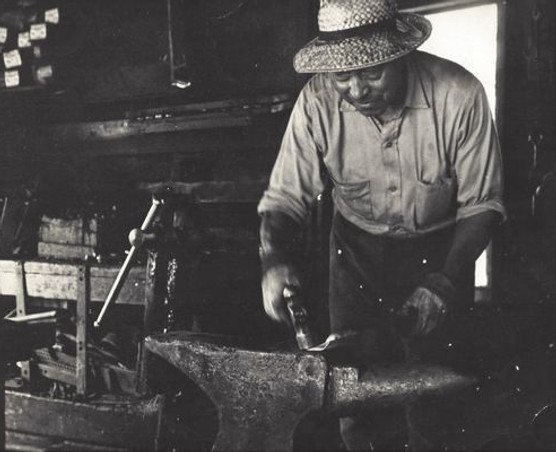
The Samuel D. Outlaw Blacksmith Shop Memorial Museum honors the life and legacy of Samuel D. Outlaw (1896–1991), a master craftsman, civic leader, and visionary entrepreneur.
Early Life & Education
Samuel D. Outlaw was born in North Carolina. He left home and went to Hampton, Virginia, where he enrolled in a four-year course in Blacksmithing and Wheelwrighting at Hampton Normal and Agricultural Institute (now Hampton University), one of the most prestigious historically Black institutions in the country. Mr. Outlaw brought both technical excellence and community-minded values to Virginia’s Eastern Shore when he relocated to Onancock.
The Shop
In 1927 he moved to Onancock, purchased a home on Boundary Avenue, and built a 20' × 50' blacksmith shop, becoming one of the first African-American business owners in the region. He operated it for 65 years, from 1927 until ill health forced his retirement in 1991. His customers were watermen, farmers, neighbors, and friends. His skills were wide-ranging from repairing bicycles, forging oyster dredges, maintaining plows, trucks, and cars, and shoeing horses. He served all members of the community regardless of race. But Mr. Outlaw’s impact extended far beyond the forge.
Civic Life
He was a prominent civic leader and a tireless advocate for Black economic empowerment. He was deeply embedded in his community; serving as Clerk for Bethel AME Church for 46 years, Sunday School Superintendent for 58 years, and was a founding member of the Eastern Shore Building & Loan Association.
Legacy
Mr. Outlaw passed away in 1994 at the age of 95. His family deeded the shop and grounds to the Town of Onancock to honor his memory. The shop is now a museum and is listed on the National Register of Historic Places, the Virginia Landmark Register, the Virginia Preservation List, and is a member of the African American Civil Rights Network, making it one of the few remaining intact examples of African American industrial heritage on Virginia's Eastern Shore.